
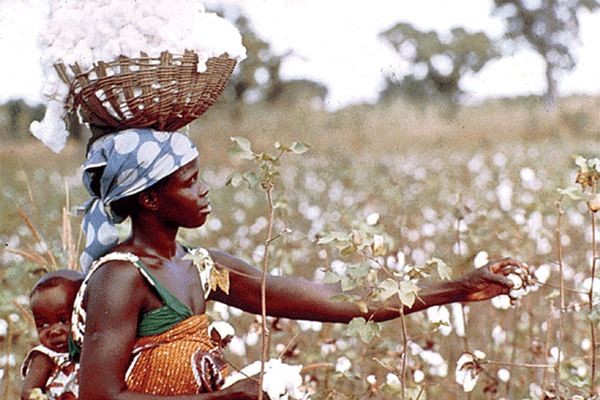
Cotton farming is a vital economic driver in Zimbabwe, supporting over 200,000 smallholder households. Primarily grown as a drought-tolerant cash crop in hotter, semi-arid regions (such as Gokwe, Sanyati, Muzarabani, and Chiredzi), it forms the backbone of local rural livelihoods and provides crucial raw materials for domestic textile and cooking oil industries.
Core Farming Dynamics
- Small-Scale Dominance: Production is driven by smallholder farmers operating plots averaging 1 to 2 hectares.
- Contract Farming: The majority of farmers operate under contract schemes. Contractors—predominantly the Cotton Company of Zimbabwe (Cottco)—supply necessary production inputs (seed, fertilizers, and chemicals) on loan.
- Seasonality: Planting begins with the summer rains in November, and the manual harvesting and marketing season traditionally runs from May through July.
Key Growing Regions
Cotton is largely concentrated in Natural Regions III, IV, and V, which experience the requisite hot, lower-altitude conditions:
- Midlands: Gokwe South and North (the country's primary growing hub).
- Mashonaland Central: Muzarabani, Guruve, and Mt Darwin.
- Manicaland & Masvingo: Checheche, Chiredzi, and Mwenezi.
- Matabeleland North: Binga.
Economic and Industry Importance
- Export Earner: Cotton is historically Zimbabwe's second-highest agricultural export earner after tobacco. Around 70% of the lint produced is exported globally, while 30% is reserved for the local textile market.
- Downstream Value Chain: Ginned seeds supply the local edible oil and soap manufacturing industries, while cotton seed cake is a primary component for the stockfeed industry.
Challenges and Outlook
The sector faces structural challenges, including vulnerability to erratic weather patterns, fluctuating international market prices, and payment disputes. To address this, organizations like the Agricultural Marketing Authority (AMA) continually work to introduce demonstration plots to improve seed quality and train farmers in modern, climate-smart agronomic practices.