
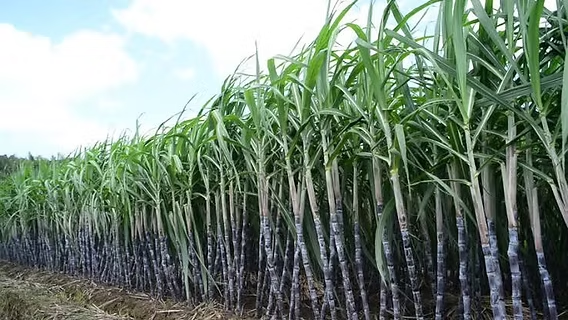
Sugarcane is a highly productive commercial crop grown primarily in the Lowveld region of Zimbabwe (around Triangle and Chiredzi) under large-scale irrigation. For farmers exploring sugarcane alternatives or related crops, Zimbabwe's climate supports several similar or high-yield tropical and semi-tropical alternatives.
Here are the key crops similar to or compared with sugarcane in Zimbabwe:
1. Sweet Sorghum (Mapfunde/Amabele)
- The Concept: Sweet sorghum is a grass closely related to sugarcane. It is drought-tolerant and stores sugars in its stalks.
- Local Relevance: Institutions like Lupane State University in Matabeleland North have explored sweet sorghum as a viable, low-water alternative to sugarcane for syrup and ethanol production.
2. Bananas
- The Concept: While structurally different, bananas thrive in the exact same environments and micro-climates as sugarcane, such as the Honde Valley in the eastern highlands.
- Local Relevance: Bananas are a staple cash crop that thrives in the high-humidity and ample water supply of valley regions across Zimbabwe.
3. Sugarcane in Local Micro-Climates
- The Concept: Sugarcane itself is quite adaptable beyond massive commercial estates.
- Local Relevance: In areas like the Honde Valley (e.g., Ngarura, Samanga, and Sagambe), indigenous and hybrid varieties (such as Zimbe tsvuku and Chimoyo) are grown on smaller scales for local consumption and regional trade.
Agronomic Challenges to Watch
If you are cultivating thick, fibrous, sweet-stalked grasses like sugarcane, you must manage opportunistic creepers (such as Ipomea species and other invasive vines). These vines use sugarcane and similar crops for support, competing for nutrients and reducing crop yield.